

The Significance of Shavuot in the Torah
The Significance of Shavuot in the Torah
Dr. Zvi Shimon
The holiday of Shavuot actually culminates an extended period begun in Passover. The period between the beginning of Passover and 'Shavuot' is a period of counting. Every evening, Jews count the days and weeks that have passed since the second day of Passover. Why is everybody counting? The day "after the Sabbath" an 'omer' (a measurement according to most commentators) of the first harvest (the barley harvest), is elevated by the kohen in an offering to God. From this day "after the Sabbath" on which the 'omer' is offered, the Torah instructs us to count until the fiftieth day, a sacred holiday on which two loaves of bread are offered before God. The fiftieth day is commonly called "SHAVUOT" ("weeks," in reference to the counting of the seven weeks leading to the holiday).
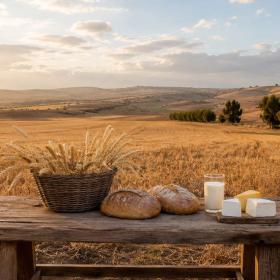
Why do we count forty-nine days between the offering of the omer and the bread offering? While Jewish tradition connects the holiday of Shavuot to the time of the giving of the Torah, Shavuot in the Torah is actually the harvest festival. In line with this, the Jewish Italian commentator Ovadia Sforno (approx.1470-1549) focuses on the agricultural significance of the holidays. Passover is not only the time of our redemption from slavery in Egypt. It is also the period of the ripening of the grains. The omer, offered on the second day of Passover, is offered from sheaves of barley, the first grain to ripen. It is an offering of thanks for the ripening of the produce. Shavuot, the harvest festival, expresses our thanks for the harvest through the offering of two loaves of bread. Since Shavuot is the period of the wheat harvest, the offering is brought from wheat.
The novelty of Sforno's explanation is his connection of this theme to the counting of the omer. According to Sforno the counting is a form of prayer for the success of the harvest. The period between Passover and Shavuot is the critical stage for the success of the harvest. The counting of the omer spans this critical period and is an ongoing prayer for its successful culmination. The counting of the omer culminates with Shavuot where we give thanks through the harvest offerings.
This interpretation finds much support in the text especially in the fact that the counting of the days of the omer links two harvest offerings thereby emphasizing the agricultural component of this complex of commandments. The return to the land of Israel and the agricultural development of the land allows us to reconnect to the agricultural-religious ideas behind the holiday of Shavuot and give thanks to all the plenty from which we enjoy in the good land which God has given us.
Chag Sameach!
Last Updated Date : 14/05/2026